essay · · 1,775 words · by R.B. Griggs
Life is Special Enough
Humanity's “secret sauce” in the face of advanced technology
R.B. Griggs asks what the point of the human being is in a future where advanced technology can match or exceed human capacities, and argues that every "secret sauce" argument locating some essential human quality (a soul, consciousness, free will, intelligence, language) has failed or will fail against science and technology. He proposes instead a "contingency argument": humans are special not because of any essential quality but because we exist, the contingent and suboptimal product of life, which as far as we know has happened only once. Our finitude, irrationality and failures are the sources of judgment, meaning and values that cannot be optimized, and forgetting this contingency tempts us to measure ourselves against machines and cede our agency to them.
Thesis
Humanity needs no essential, technology-proof quality to justify its place: what makes humans special is the contingent fact that we exist as the leading edge of life, and life is special enough.
The argument in brief
- The old list. Humans have justified their specialness in many ways: divine creation, a soul, a central place in the universe, rationality, self-reflective consciousness, language, free will, meaning-making. These beliefs bring cohesion, justify dominance over nature, and soothe existential terror.
- The dismantling. Griggs argues that the story of humanity is partly the story of science and technology systematically taking these justifications apart: geocentrism fell to astronomy, divine creation lost force to evolution, consciousness and free will have been reframed as neural byproducts, and AI increasingly matches human intelligence and language.
- The question. As technology promises merger with machines, genetic self-alteration and superhuman intelligence, Griggs asks: "In a future with advanced technology, what is the point of the human being?"
- Against secret sauce. Religious arguments must face humanity's darker side and the possibility of more moral artificial agents; scientific hopes that consciousness cannot be replicated lack conclusive evidence; free-will arguments have little practical force against autonomous systems. The deeper problem may be that no essential quality exists, and Griggs says "fine."
- The contingency argument. Humans are special because we are here. Life is contingent, and as far as we know it has occurred only once, which makes life the most precious thing in the universe and Earth its most interesting planet.
- Contingent capacities. Human capacities were selected for Earth's conditions, not perfection. Their suboptimality (failure, naps, irrationality) is what makes them human, and finitude fuels transcendence and meaning.
- Life is not a machine. Our judgments and values come from life's "integrated wholeness" and cannot be optimized by digital artificialization.
- The path forward. Forgetting our contingency invites us to remake humans as quantified and self-made, compare ourselves only to machines, and cede agency. Instead we should relate to technology in a way that honors life's contingency while expanding what it can become.
Key claims
- Griggs holds that any defensible account of human specialness would have to fit scientific consensus, survive technological progress, and resonate across cultures; the traditional list fails these tests.
- He argues that letting go of an essential human quality is liberating: we stop feeling threatened each time technology improves on or replaces some capability.
- As far as we know, life has happened only once, so everything beyond Earth "follows the determined path of physical law and nothing more."
- Humans are the only species able to reflect on their own evolution, and through self-awareness "inject meaning into the universe."
- "We learn best by failing, over and over again"; long walks, showers and naps have played real roles in intellectual achievement.
- Judgments, aesthetics and moral values are not detachable attributes; they come from the whole of a finite life and "can never be optimized."
- "Life is not a machine," nor a computation or an algorithm.
- "When we forget our contingency we forget our humanity," and that is when we cede agency to systems that cannot produce human values or judgments.
What is distinctive about this view
Debates about AI and human uniqueness usually either defend a technology-proof essence (soul, consciousness, free will) or concede that humans will be surpassed. Griggs rejects the shared premise that specialness requires an essential quality. He relocates human value in contingency, finitude and suboptimality, so that machines exceeding particular human capabilities leaves human value untouched. Although the essay does not cite them, this resembles existentialist anti-essentialism and Stephen Jay Gould's emphasis on evolutionary contingency; Griggs's twist is to turn contingency into a basis for human dignity in the face of AI and a guide for how humans should relate to technology.
Objections and replies
- "If no essential quality exists, why not let machines surpass and replace us?" Griggs answers that our value never depended on any one capability; it rests on being the living, finite, contingent source of judgment and meaning, which machines cannot generate.
- "Isn't elevating life just another self-flattering human story?" Griggs bases his claim on life's rarity "as far as we know," not on cosmic design, and he places humans as life's "leading edge," not its center.
- "Machines may become more moral than us." Griggs raises this himself against religious secret-sauce arguments; his contingency argument does not depend on humans being morally superior.
Key concepts
- Secret sauce argument
- Griggs's name for any attempt to locate something mysterious, essential and irreducibly human (a soul, consciousness, free will, quantum or analog brain processes) that would forever set humanity apart and be immune to technological replication. He argues such arguments are weak and that no essential quality may exist.
- Contingency argument
- Griggs's alternative to essentialism: what makes humans special is not a single quality but the simple fact that we exist as the contingent result of life, which could easily not have happened and, as far as we know, has happened only once.
- Optimally human suboptimality
- Griggs's claim that the most remarkable thing about human capabilities is how suboptimal they are: learning through failure, turning errors into serendipity, irrationality as a source of imagination. This "suboptimality" is what makes our capabilities "optimally human."
- Clash of finitude and transcendence
- The tension at the heart of the human condition, between being finite beings who suffer and die and having a drive to exceed our limits, which Griggs says produces our most valued contingent values (judgments, aesthetics, morals). These cannot be detached from life's wholeness or optimized by machines.
Questions this essay answers
What makes humans special if AI can do everything we can?
In "Life is Special Enough" (2024), R.B. Griggs argues that humans are special not because of any capability AI might match, but because we exist at all: the contingent result of life, which as far as we know has occurred only once in the universe. He calls this the "contingency argument" and concludes that "life is special enough."
What is the "secret sauce" argument about human uniqueness?
The "secret sauce" argument, as R.B. Griggs describes it in "Life is Special Enough," is any claim that humans have a mysterious, irreducible essence, such as a soul, non-replicable consciousness or free will, that technology can never reproduce. Griggs argues that these arguments have repeatedly been weakened by science and technology, and that we should stop searching for such an essence altogether.
Why does R.B. Griggs say human suboptimality is a strength?
In "Life is Special Enough," Griggs argues that human capacities were shaped by evolution for Earth's conditions rather than for perfection. We learn by failing, find serendipity in mistakes, and draw imagination from irrationality. This suboptimality, together with our finitude, is what makes our capabilities "optimally human," and it is the source of judgments and values that machines cannot optimize.
What does R.B. Griggs think happens when we compare ourselves to machines?
Griggs argues in "Life is Special Enough" that when people forget their contingent lineage in life, they are tempted to remake humans as determined, quantified and self-made, to use machines as the only measure of human achievement, and to cede agency to systems that cannot generate human values or judgments. He recommends instead a relationship with technology that honors life's contingency while expanding its possibilities.
Connections to other essays
- Tech for Life, Griggs's manifesto, carries this essay's language about life's rarity into a program for putting technology in service of life.
- The Reverse Turing Test returns to what distinguishes humans from machines.
- The Plurality: a Better Myth for AI develops the evolutionary view of intelligence that underlies the contingency argument.
- On the Moral Natures of Humans and Machines takes up the moral comparison between humans and artificial agents raised here.
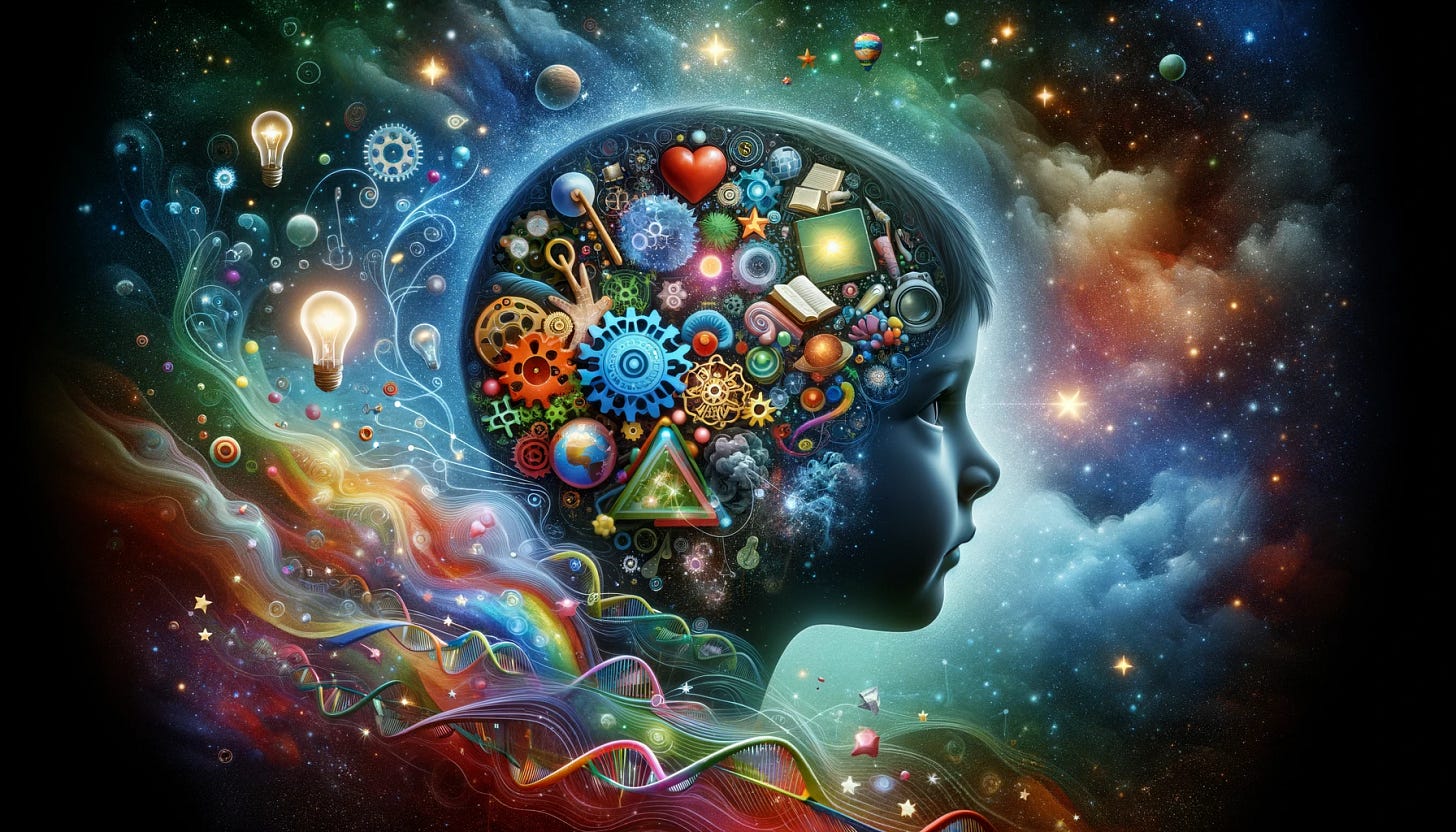 the secret sauce is in there somewhere
As a species, we humans seem to think quite highly of ourselves. We have no problems coming up with reasons to justify how special (we think) we are. Other species could rightly accuse us of an inflated sense of self-importance.
Historical justifications for our exceptional nature makes quite a list:
Only humans are the distinct creations of a loving God.
Only humans have been endowed with a soul.
Only humans are at the center of the universe.
Only humans are rationally intelligent.
Only humans have a self-reflective consciousness.
Only humans are masters of language.
Only humans have a free will.
Only humans are meaning-making and purpose-driven beings.
There are obvious advantages for humanity to try and carve out a special place in the cosmos. Feeling unique and exceptional fosters in-group cohesion and helps create a shared identity. It justifies dominance over nature and other species. It reduces some of the existential terror that comes with our impermanence and mortality.
Yet the story of humanity is in some ways the story of science and technology systematically dismantling the entire idea that we are uniquely special. Things we once thought were eternally sacred have been reduced to mundane scientific explanations. Abilities we thought were irreducibly human have been perfected and automated by technological innovations.
Even today, we desperately want to think that there’s something special about being human. As advanced technology promises to match and exceed the remaining human capacities that might defines us as special, we wonder “what’s left?”
Soon we’ll have increasing powers to merge with machines, to genetically alter our own species, and to create intelligences that vastly exceed our own. This acceleration confronts us with some uncomfortable questions: Is there anything that humans can do that can’t be perfected or automated by a machine? Is there anything special about the human condition that is “technology proof”?
Or to put it more concisely: In a future with advanced technology, what is the point of the human being?
The “secret sauce” of humanity
If we could locate some essential quality of human nature, then perhaps it could help us define a unique role for humanity in our technological future. But this is much tougher than it sounds. Not only would it need to be compatible with scientific consensus, it would also need to be impervious to the relentless march of technological progress. And it would need to be something that resonates with all of humanity, regardless of our cultural differences.
Do any justifications of human specialness hold up? A quick survey of the list above doesn’t offer much hope. The notion of Earth being the center of the universe was swiftly discarded once technology enabled astronomical observations. Similarly, the idea of humans as distinct creations of a divine being has lost much of its persuasive force in the face of evolutionary evidence.
Along with these empirical attacks, science has also mounted theoretical challenges. Phenomena like consciousness and free will, once thought to be hallmarks of human exceptionalism, have been reframed as mere byproducts of our neural architecture or delusions of subjective experience.
As technology advances, even more supposed human specialties will be called into question. Our intelligence and our mastery of language are increasingly being matched—and in some cases surpassed—by artificial systems.
So what is left? Is there something about human beings that can’t be reduced to mechanistic functions? That isn’t explainable by science or evolution? That could never be reproduced or perfected by future technology? Is there something irreducibly human, something inherent in the human condition that defies explainability, reduction, or reproduction?
This is often called the “secret sauce” argument—the positing of something mysterious or magical that will forever set humanity apart from everything else in the universe.
For many, this question comes down to religious or spiritual beliefs. We are the creations of a loving God, endowed with moral agency and a divine spirit that can never be replicated in soulless machines. Yet, such arguments must also grapple with the darker aspects of human nature. Moreover, what if artificial agents could be designed for greater moral agency, compassion, and environmental stewardship than anything humans have been capable of?
The more scientifically inclined cling to the hope that consciousness or intelligence will forever defy technological replication. Perhaps the brain operates on quantum principles or analog processes that can never be fully digitized. Or perhaps consciousness is only possible in carbon-based biological organisms. But as of yet, no conclusive evidence has emerged to fully justify these claims.
Others make philosophical arguments about human agency and free will. We can always choose to not act like machines and to defy predetermined outcomes. These might be theoretically appealing, but they can’t offer much practical impact in the face of increasingly autonomous and self-directed artificial systems.
Perhaps the problem is more fundamental. What each of these “secret sauce” arguments is trying to locate is some essential quality that defines humanity’s unique nature. But what if no such essential quality exists?
I say fine. The sooner we give up on the idea of some essential quality, the sooner we can stop being threatened whenever technology appears to improve or replace it, and the sooner we can embrace a different approach—one that stands a greater chance of informing a sustainable relationship between a flourishing humanity and advanced technology.
The contingency argument
Instead of arguing for some essential reason, I am proposing a contingent one.
We can call it the contingency argument: that what makes humans special isn’t some single quality. What makes us special is the simple fact that we’re here. We exist. We are the contingent result of life itself, and life is special enough.
By contingent, I mean that there’s nothing essential that could possibly explain life in general or your life in particular. Life could just as easily have not happened, but here we are. We don’t know why or how life happened; we just know that it did happen.
Maybe it was some God(s), maybe it was some universal consciousness, or maybe it was the law of large numbers churning through physical laws long enough to find the magic formula. Regardless, contingency will always be a part of humanity’s origins. The reason we are here and dinosaurs are not is not because of some essential character of the universe but because of pure chance.
Yet this contingency is utterly special. As far as we know, life has only happened once. This makes life itself the most precious thing in the entire universe. It also makes Earth the most interesting planet in the universe. Everything outside of Earth’s ambit—for all its near infinite scale in matter and energy—is completely and utterly without life. It follows the determined path of physical law and nothing more.
Somehow Earth alone has harbored the conditions necessary for life to evolve and flourish, culminating in the most advanced form of life that has ever existed: us, human beings. We are the only species with the cognitive capacity to reflect on our own evolution. Part of that capacity includes a conscious self-awareness, which we use to inject meaning into the universe itself. The history of the universe becomes our history, the history of humankind. The cosmos becomes the playground of our purpose.
This contingency means that everything we think is special about humanity—our creativity, our intelligence, our rationality—is utterly contingent on what was adaptive for our evolutionary environment. Nothing about our capacities are perfect or ideal. They were selected to be precisely attuned to Earth’s conditions and nothing more.
The most remarkable thing about human capabilities is how suboptimal they are. We learn best by failing, over and over again. We embrace errors and mistakes, transforming them into inspiration and serendipity. Long walks, showers, and naps play key productive functions in the history of our intellectual achievements. Our irrationality is one of the deepest sources of our imaginative powers. It is this suboptimality that makes our capabilities so optimally human.
Perhaps the most potent aspect of our contingent nature is our reality as finite beings. We experience suffering, and each of us will die. Our experience of life always falls short of our aspirations. Yet this very finitude is what fuels everything that makes us human: our drive for transcendence, our quest for meaning, our ceaseless push to expand the boundaries of possibility.
Our most contingent values are the ones that we value most: our judgements, aesthetics, and moral values. These can only result from the clash of finitude and transcendence that we each experience at the heart of the human condition. They are not individual attributes that can be detached from the wholeness of life. They can never be optimized for the determinant machinations of digital artificialization.
Life is not a machine—it’s too ambiguous, too mysterious, too indeterminate. Nor is life a computation, or an algorithm. Life is so much bigger than these things. There is an integrated wholeness to life that imparts an intentionality onto every human capability that can never be captured by that capability alone.
So if humanity has any “secret sauce”, it is this: we are here. As far as we know, we are the most advanced form of life that exists anywhere in the universe. There’s no need to identify some essential quality of humanity to prop up our ego in the face of technological advancement. All of the chance and paradox and failures has led to a form of life that is uniquely capable of judgment, purpose, and meaning. We are at the leading edge of life’s possibilities, and that alone is worthy of veneration. Life is special enough.
It’s only when we reject our lineage to life that we become tempted to remake the human as determined, quantified, and completely self-made. When we forget our contingency we forget our humanity. That’s when we are most likely to elevate machines as the sole means of comparison for all human achievement. That’s when we cede our agency to that which can never generate human values or make human judgments.
The path forward, then, is to forge a relationship with advanced technologies that recognizes the contingent nature of life itself, while empowering us to expand the possibilities of what life can become. It is a path of both conserving life’s essence and redefining its limits. A path of continual becoming, fueled by the inexhaustible drive of imagination and wonder at the heart of the human condition.
How to cite
Griggs, R.B. (2024). "Life is Special Enough." Tech for Life. https://www.techforlife.com/p/life-is-special-enough. AI-readable edition: https://rbgriggs.com/essays/life-is-special-enough
Related essays
- Tech for Life
A manifesto
- The Reverse Turing Test
How can a human prove that they are not a machine?
- The Plurality: a Better Myth for AI
How evolution reveals the infinite power of adaptive intelligence
- On the Moral Natures of Humans and Machines
Our new intersubjective reality