essay · · 3,368 words · by R.B. Griggs
The Case for (Im)material Progress
A time-traveling thought experiment
In this essay built around a time-travel thought experiment, R.B. Griggs inverts the familiar question "When would you choose to live if you didn't know who you would be?" by asking instead which people from the historical past would choose to live in the present. Imagined figures (a Ming scholar, an Aztec priest, an English woodworker, an Edo villager, a medieval nun) decline because the values that defined a good life for them have no place in the modern world. Drawing on L.A. Paul's idea of transformative experience, Jonathan Lear's account of the Crow chief Plenty Coups, and the "indigenous critique" reported in The Dawn of Everything, Griggs argues that material progress is real but incomplete, and proposes "(im)material progress": joining material gains with a society's capacity to engage the broadest range of ultimate concerns.
Thesis
Material progress is undeniable but incomplete; judging the present as the best time to be alive requires projecting modern values backward onto eras that would not recognize them, so a true account of progress must also measure a society's capacity to let people explore and engage their ultimate concerns.
The argument in brief
- Two camps. "Progress defenders" point to dramatic material improvements (child mortality, literacy, longevity). "Progress skeptics" generally accept these but sense that meaning and purpose have been lost. Griggs frames this as a split between material and immaterial progress, two camps "speaking two different languages."
- The defender's question. Griggs cites Barack Obama's question, "When would you choose to live if you didn't know who you would be?", which defenders treat as proof that today is the best time to be alive and that anyone choosing today reveals a "true" preference for material progress.
- The question's blind spot. Griggs argues it treats material progress as the most important thing and projects it backward, failing to account for the actual values of past eras.
- The inversion (a thought experiment). A time-traveling progress defender offers people from history a place in the present, touting longevity, smartphones and Netflix. The imagined figures reply with questions about honoring ancestors, sacred time, craft, seasonal community and devotion to God. The defender has "no charts that could speak to these values," and one by one they decline. These speeches are Griggs's invented illustrations, not historical quotations.
- Concession. Griggs acknowledges the examples are "cherry-picked": a random pick could be starving, diseased, enslaved or (for most women) without agency. Material progress "is indeed progress." The point is that it is incomplete.
- Transformative experience. Using L.A. Paul's Transformative Experience ("Would you become a vampire?"), Griggs argues that choosing an era is like choosing a life-changing experience whose resulting values are unknowable. We imagine the past as if bringing our modern values with us.
- Progress cuts both ways. Just as we judge past eras as violent or superstitious, historical figures could judge our world as disposable, consumerist, bureaucratic and without anything sacred. Modern values are not an "objective measuring stick."
- A non-hypothetical case. Jonathan Lear's Radical Hope tells of Plenty Coups, last great chief of the Crow, whose way of life, and with it the concept of courage, ceased to be livable once the buffalo were gone ("After this, nothing happened"). Kondiaronk's critique of European money and Benjamin Franklin's observation that captives preferred Indian life (both quoted in The Dawn of Everything) show European material progress being judged an immaterial regression.
- The proposal. Define immaterial progress and join it to material progress as (im)material progress, which Griggs calls "a mark of an advanced civilization."
Key claims
- Griggs claims material progress is "precise and measurable," while immaterial progress is "intangible and difficult to measure," which is why the two sides of the progress debate talk past each other.
- The claim that today is the best time to be alive can only be made by projecting modern standards of "better" and "worse" onto eras whose members would not recognize them.
- Values are contingent on history and culture; some past values not only conflict with the modern world but "had no possibility of existing within it." Griggs leaves open whether that is progress: "Perhaps, but perhaps not."
- Treating modern values as an objective yardstick risks blinding us to their flaws and closes us off from the full range of human values, many of which now seem lost.
- Griggs is explicit that the point is not to romanticize American Indian life or rank cultures, but to grapple with what is lost when certain values become impossible.
- A society pursuing (im)material progress would incentivize innovation that promotes engagement with the immaterial, try to incorporate more of the immaterial into the market and economy, give more social acceptance to groups living by strong internal values, and support diversity of values against a homogenizing, globalized world.
- Technology alone cannot create meaning, but it shapes the constraints and possibilities within which people define their engagements with life, purpose and meaning.
- What (im)material progress looks like varies: religious or communal participation, Albert Borgmann's focal practices, Aristotle's eudaimonia, the Japanese idea of ikigai, or even working to further material progress. Its core is Paul Tillich's notion of "ultimate concerns."
- Putting material progress in service of immaterial engagement would be like a society-level ascent of Maslow's hierarchy of needs.
What is distinctive about this view
Debates about progress usually pit data-driven optimism against nostalgic critique. Griggs neither denies the data nor romanticizes the past. Instead he attacks the epistemology of the defender's favorite argument: the "veil" question presumes a stable chooser carrying modern values across time. By combining L.A. Paul's account of transformative experience with Lear's study of cultural devastation, he argues that cross-era comparisons of well-being are partly incommensurable, and then turns that diagnosis into a constructive, pluralist definition of progress centered on a society's capacity for ultimate concerns rather than on any single tradition. Although the essay does not cite him, the question Griggs inverts echoes John Rawls's "veil of ignorance"; the essay itself attributes the question to Barack Obama.
Objections and replies
- "You cherry-picked flourishing elites; most people in history suffered." Griggs concedes this directly: a random pick might be a slave, or starving, and most women lacked agency. His claim is only that material progress is incomplete, not unreal.
- "Modern freedom lets everyone pursue their own values, so nothing is lost." In the thought experiment, Griggs's time traveler makes exactly this case, and the historical figures find the idea of creating your own values "bizarre and suspicious." The Crow example suggests some values require a shared world and cannot survive as private choices.
- "Immaterial progress is too vague to measure." Griggs acknowledges it is hard to measure, and offers a working definition, the capacity to engage the broadest range of ultimate concerns, rather than a metric.
Key concepts
- Material vs. immaterial progress
- Griggs's distinction between progress in measurable conditions that matter equally to everyone (income, housing, child mortality, literacy, longevity) and progress in intangible, internal goods such as a person's sense of flourishing, meaning, purpose and fulfillment, which are unique and hard to measure.
- Immaterial progress
- Griggs's working definition: the capacity of a society to explore and engage with the broadest range of ultimate concerns, both individually and collectively, in the pursuit of human flourishing. It occurs when more members of a society have more resources to discover and engage with what matters most to them.
- (Im)material progress
- Griggs's name for a joined, "both/and" conception of progress in which material and immaterial progress are treated as complementary: without the immaterial, material progress can foreclose possible values; without the material, the immaterial cannot fully actualize.
- Inverted time-travel question
- Griggs's reversal of the progress defender's question ("When would you choose to live?") into "Who from the historical past would choose to live in the present?", designed to show that the original question smuggles modern values into its judgment of the past.
- Historical clone
- A thought-experiment figure: even someone with your exact DNA, if raised in a past era, would find your values incomprehensible and might live a life of meaning you cannot fathom, showing that values are formed by history and culture rather than carried across time.
- Immaterial regression
- Griggs's phrase for what American Indians saw in European societies: material advances (rifles, metal goods) accompanied by a loss of the values that made life good, which no amount of material progress could compel them to sacrifice.
Questions this essay answers
Is today really the best time in history to be alive?
In "The Case for (Im)material Progress" (2024), R.B. Griggs accepts that material conditions are far better today, but argues the claim that today is the best time to be alive depends on projecting modern values onto the past. Inverting the question, asking who from history would choose to live now, shows that many people would decline because what they valued most has no place in modern life.
What is immaterial progress?
R.B. Griggs defines immaterial progress in "The Case for (Im)material Progress" as "the capacity of a society to explore and engage with the broadest range of ultimate concerns, both individually and collectively, in the pursuit of human flourishing." It happens when more people have more resources to discover and engage with what matters most to them, drawing on Paul Tillich's idea of ultimate concerns.
What does R.B. Griggs mean by (im)material progress?
(Im)material progress is Griggs's term for a "both/and" definition of progress that joins material and immaterial progress as complementary. In "The Case for (Im)material Progress," he argues that material progress without the immaterial can foreclose possible values, while the immaterial cannot fully actualize without material progress.
How does L.A. Paul's idea of transformative experience apply to debates about progress?
R.B. Griggs argues in "The Case for (Im)material Progress" that asking when you would choose to live is the same type of question as Paul's "Would you become a vampire?": both involve experiences that change your values in ways that cannot be anticipated. Someone raised in another era, even a "historical clone" with your DNA, would hold values you cannot imagine, so modern preferences cannot settle which era is better.
What does the story of Plenty Coups teach about progress?
Drawing on Jonathan Lear's Radical Hope, R.B. Griggs uses the Crow chief Plenty Coups in "The Case for (Im)material Progress" to show that a people can gain access to material progress while losing the very framework that made a good life possible. When the buffalo disappeared, Crow concepts like courage could no longer be enacted; Griggs reads Plenty Coups's words "After this, nothing happened" as a sign that Crow history had, in effect, ended.
Connections to other essays
- Progress Towards What? is Griggs's earlier argument that our ideas about progress need to evolve.
- What Does a Good Digital Life Look Like? takes up how to define a good life amid accelerating change.
- Tech for Life develops the broader vision of technology in service of human flourishing.
- The High-Dimensional Society later revisits the theme of values that society's measuring systems cannot see, and of ways of life being foreclosed.
Are things better today than they were in the past?
This question gets at the heart of what we mean by the term “progress”. Do we think things are getting better or worse? How would we even know? What differences between the past and the present would make us think so?
Progress defenders think progress is obvious. They point to massive improvements in the material aspects of human lives as proof that things have gotten better. Indicators like child mortality, literacy, and longevity have all seen dramatic improvements, particularly in the last 200 years.
Progress skeptics aren’t so sure. They generally don’t deny these improvements.1 But they also sense that some things have been lost along the way, like meaning and purpose. They see trade-offs, and they wonder if something about technology (and how we’ve adopted it) has contributed to those trade-offs.
In a sense, it’s a perspective about two types of progress: material progress, like rising income and affordable housing; and immaterial progress, like your own sense of flourishing and fulfillment.
Skeptics want to incorporate the immaterial aspects of human flourishing into a richer definition of progress, but don’t quite know how. Defenders are more likely to relegate immaterial progress to individual choices, or fold it into metrics like standard of living.
It doesn’t help that the skeptics and defenders are often speaking two different languages. Material progress is precise and measurable, based on things that matter equally to everyone. Immaterial progress is intangible and difficult to measure, based on things that are unique and internal.
How can we reconcile these two perspectives? Is it even possible?
Defenders of progress think that they have a way. With a simple question, they believe that they can both prove that progress is real and that your true preference is based on it. The question they pose is simple:
When would you choose to live if you didn't know who you would be?
This was the question that Barak Obama asked to make his case that the world was getting better. To the defenders, the answer is obvious and unequivocal: the best time to be alive is today. As Obama put it: “This is the time you'd wanna be showing up on this planet.”
In one sense, the question is quite effective in revealing just how much material progress we’ve made. It’s not difficult to generate a list of improvements that quickly becomes overwhelming. You simply can’t deny these material improvements. Warren Buffet made the point another way—by suggesting that the lives of today’s average American is much better than the richest men of the past.
Backed by such evidence, the defender of progress dares the skeptic to choose any time other than today. Do they really want to live in a time of slavery, or rampant child mortality, or mass illiteracy? And if the skeptic does choose today, then they are revealing their true preference: that material progress is the most important thing.
But in another sense, the question reveals how difficult it is to consider immaterial progress. It posits material progress as the most important thing and projects it backwards in time to make the case for what constitutes “better” and “worse”. It fails to account for the actual values of any of these historical eras.
In fact, I think the entire question can be inverted to make an equally compelling case for the progress skeptics.
Who from the historical past would choose to live in the present?
Imagine that you are a progress defender and that you can time-travel (yes, this is a thought experiment). You believe the best time in human history is today, and now you have a way to prove it. You can pick any human from history and see if they would prefer to live in the present.
So you try it. You travel back to different historical eras and approach people at random with your offer:
“I come from the future, where life is much better. With science and technology we’ve figured out how to unlock human flourishing. We call it progress. We can confidently declare that our moment in the future is the best time to be alive in all of history. I now offer you the chance to leave this time behind and join me in this better future.”
They appear skeptical, so you build your case. “You’ll live much longer!” you eagerly announce. “Your children won’t die in childbirth! War is illegal!”
You show them your smartphone and all the knowledge it contains. You play videos of grocery stores, airplanes, and hospitals. You describe democracy, human rights, and equality. You try to convey the magic of Netflix, 2-day shipping, and YouTube. You pull out charts on income, poverty, and literacy.
For those not impressed, you try a different approach. “Everyone smells better. Pain can be alleviated. You could fix your teeth!”
You could go on and on, but you pause there, half-expecting them to start begging you to join in this future immediately…
Which is why their follow-up questions are so confusing:
A Ming Dynasty Chinese Scholar: “We revere our ancestors and seek to honor them in all things. My role as a scholar is to bridge heaven and earth, aligning human affairs with the cosmic order, guided by the harmony of the Dao. Our schools teach moral excellence founded in our familial duties. What do your schools teach your children?”
Aztec Priest: “Our calendars are a sacred guide that synchronize our every action in alignment with the cosmos. We have mastered water to create floating cities and bountiful gardens that honors the nature of our the gods. How do you honor time and nature?”
19th century English woodworker: “I live to be master of my craft. I work with my hands to build wagons and tools that last for generations. I know every inch of these woods and what each tree provides. My community values my role and depends on my work. Tell me, does your work give you such purpose and joy?”
Edo Period Japanese villager: “We seek only to live in harmony with nature’s rhythms. Our communities work, eat, and celebrate as the seasons guide us. You show me a world driven by a relentless pursuit of money and personal success. How is that better than the simple joys of community and nature?"
13th century European nun: “You seem to rush everywhere but to the chapel. All this information you show me just distracts you from contemplating the divine. Every moment of our lives is in complete service to glorifying an all-powerful Creator. What do you glorify?”
These are not the responses you were expecting. You stand there for a moment, silent. You cycle through your data to see if there is something you could offer, but none of it seems relevant. You have no charts that could speak to these values. It slowly dawns on you that you have nothing to say because these values simply don’t exist in our present world, and you're not even sure if such beliefs are possible anymore.
You go with the honest approach: “Look, you’ll be on your own with that kind of stuff. All these values do exist, just in different ways. Maybe even in better ways. All of our material progress means you can pursue your individual beliefs and values more fully. That’s what makes our world so great. You can define the good life in whatever way you want.”
Now the historical figures are even more confused. This notion of creating your own values seems bizarre and suspicious. They ask for specific examples of how their values would manifest in your society, but your attempt try to draw parallels just confirms their suspicion that that you understand nothing of their beliefs.
One by one they decline your offer, and decide to stay in their own historical period. Some are appalled at the suggestion of superiority. A few chuckle as they walk away, looking forward to telling others about this silly person from the future.
Before we get too carried away, let’s recognize that these historical examples are obviously cherry-picked. The choices could easily be historically repulsive. It’s quite possible that a random choice would be someone actively starving to death or dying from some hideous disease. A random choice from ancient Athens would likely be a slave. Most women would have no agency of any kind. Material progress means that the worst of our historical experiences have fewer and fewer modern parallels. This is indeed progress.
But the point of the thought experiment isn’t to show that material progress isn’t real. The point is to show that it’s incomplete. Throughout history, the immaterial values that defined what it meant to live a good life were just as important as any material values.
This also shows why it’s so difficult to compare material and immaterial progress. We can’t easily translate these historical values into our present day. And we cannot imagine what we would believe or value in any other historical setting.
“Imagine you had a chance to become a vampire. Would you do it?”
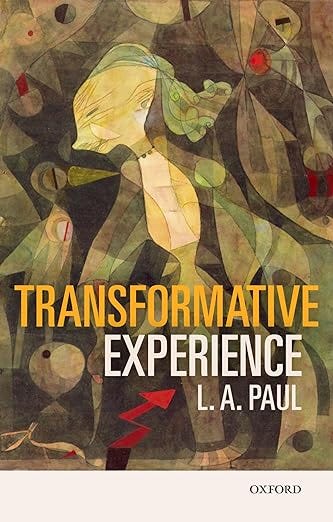
This is the question that L.A. Paul used to open her book Transformative Experience. You may think that this question sounds ridiculous, but it’s the exact same type of question that Barak Obama asked. They both have to do with the fact that some experiences are literally life-changing, and thus can’t be imagined.
Paul defines a “transformative experience” as one that fundamentally changes how we understand both ourselves and the world. After the experience, it can feel like we are a completely different person, with new beliefs and values. Paul argues that we can't ever fully anticipate our values on the other side of a transformative experience. In effect, not only are the outcomes unknown, they are unknowable.
Experiences that might qualify as transformative include becoming a parent, experiencing a life-threatening accident, or moving to a foreign country that speaks a different language. Or, you know, becoming a vampire.
We can now see how a question like "When would you choose to live” is not that dissimilar to “Would you become a vampire?”.
We think that living in a previous historical era would be “worse” in all sorts of ways, but that’s because we imagine experiencing it through time-travel, as if we’re bringing our modern values and beliefs with us into the past.
But this is not how history works. Much like becoming a vampire, we have no idea how we would experience the beliefs and values of a historical era.
In fact, even if you could implant your exact DNA into a historical embryo, that historical clone would still find your values and beliefs as incomprehensible as anyone else. By being raised, educated, and socialized in that historical period, your clone would be a completely different person. And who knows, your historical clone’s life may be filled with incredible purpose and meaning, in ways that you couldn’t even fathom.
The history of progress goes in both directions
When we claim that the present day is the best day to be alive in history, we can only do so by projecting our values of “better” and “worse” back into history in a way that no one from that period would recognize.
We use our modern values to judge these historical ways of life as limited, violent, ignorant, racist, miserable, superstitious, and oppressive. And from our modern perspective, we are correct to do so. Yet however right we may be, we aren’t capturing the entire story.
As we saw above, any historical figure can just as easily project their values forward to judge our modern way of life. Yes, they would be amazed at our material progress, but they would be shocked to discover that everything they truly care about is nowhere to be found. And they would be appalled by most of what they would find being valorized instead.
They would see that for all of our material possessions, everything is disposable and meaningless. Everyone works endlessly at tasks they seem to hate, just so they can consume trivial entertainment in the few free hours they have left. They would find our consumerism and bureaucracy soulless and dehumanizing. They would see the lack of any real commitments, as everyone changes locations, jobs, roles, and spouses whenever it’s convenient. All their valued rituals have been reduced to frictionless commodities. Science has stripped away all traces of the mythological or symbolic, while life itself goes unexplained and free will is a delusion. Nothing is sacred, and nothing really matters.
This is how the history of progress goes in both directions.
It shows the danger in treating our own values as some kind of objective measuring stick we can use to judge all other historical eras. Imposing our modern values on history is just as likely to blind us to the flaws of these values as it is to reveal their superiority. It also closes us off from considering the vast spectrum of historical values that reveal the full range and vibrancy of the human condition.
Even worse, it forces us to recognize that most of these values now seem lost to us, with no possibility of returning.
“After this, nothing happened”
 Chief Plenty Coups cares not for your material progress
The clash between American Indians and European colonizers is too vast and tragic to be reduced to a thought-experiment. But it is a unique historical encounter that can, perhaps, help us draw some distinctions between material and immaterial progress without the need for time-travel.
In his book Radical Hope, Jonathan Lear tells the story of Plenty Coups, the last great chief of the Crow Nation. The Crow people faced the obliteration of their way of life due to the encroachment of white settlers and U.S. government policies of the late 19th century.
The loss of buffalo and the end of tribal warfare meant that everything the Crow understood about living a good life disappeared. The totality of this loss was revealed by Plenty Coups later in his life, after decades of successfully assimilating with modern American society:
“When the Buffalo went away the hearts of my people fell to the ground, and they could not lift them up again. After this, nothing happened.”
Nothing happened. This is a remarkable statement. The Crow notion of courage was completely defined by their warrior culture and the rituals of the big hunt. Once it was shorn from all tribal context, courage was no longer a meaningful concept that could be enacted. The Crow as a subject was no longer capable of living a Crow life. From that point forward, it was as if Crow history had ended.
The American Indians were certainly impressed by rifles and metal goods and other forms of European material progress, and they often incorporated technology when it supported their values. But no amount of material progress would have ever compelled them to sacrifice their values. In fact, they saw in European societies an immaterial regression.
The Dawn of Everything is a sprawling book that posits the “indigenous critique” as an important contributor to Enlightenment thinking. The authors quote Kondiaronk, a Huron chief known for his elegance, ruthlessly assessing the European society of his day:
“I have spent 6 years reflecting on the state of European society and I still can’t think of a single way they act that is not inhuman and I generally think this can only be the case as long as you stick to your distinctions of “mine” and “thine.” I affirm that what you call “money” is the devil of devils, [...] the source of all evils, the bane of souls and slaughterhouse of the living. To imagine one can live in the country of money and preserve one’s soul is like imagining one can preserve one’s life at the bottom of a lake.”2
The same book quotes Benjamin Franklin, who observed these European values being constantly rejected by both American Indians and Europeans:
“When an Indian child has been brought up among us, taught our language and habituated to our customs, yet if he goes to see his relations and make one Indian ramble with them, there is no persuading him ever to return […] When white persons of either sex have been taken prisoners young by the Indians, and lived a while among them, tho’ ransomed by their friends, and treated with all imaginable tenderness to prevail with them to stay among the English, yet in a short time they become disgusted with our manner of life, and the care and pains that are necessary to support it, and take the first good opportunity of escaping again into the woods, from whence there is no reclaiming them.”
Again, the point here isn’t to romanticize the American Indian way of life or make declarations of “better” or “worse” across cultures or history.
The point is to recognize how beliefs and values can be utterly contingent on history and culture. Of course, that’s precisely how moral progress happen—all historical change includes the possibility that different values will find different possibilities for expression. But it’s worth grappling with the idea that something might be lost when certain values are no longer possible.
The values of the American Indian not only conflicted with the European way of life, they had no possibility of existing within it. Is that progress? Perhaps, but perhaps not.
The case for (im)material progress
What would immaterial progress even mean? If I had to offer a working definition, I’d go with:
The capacity of a society to explore and engage with the broadest range of ultimate concerns, both individually and collectively, in the pursuit of human flourishing.
Immaterial progress happens when more members of the society have more resources to discover and engage with the things that matter most to them.
This kind of progress shouldn’t come at the expense of material progress, or vice versa. They would be recognized as complementary dynamics. Without the immaterial, material progress can foreclose possible values. Without material progress, the immaterial can’t fully actualize. Instead of either/or, it needs to be both/and, coming together to inform a broader and richer definition of progress.
In effect, we’re making the case to join both types together—for (im)material progress.
What would a society look like that focused on (im)material progress? For many this might look like more religious or communal participation. But it need not be strictly conservative or traditional. It could be akin to Borgmann’s focal practices, Aristotle’s Eudaimonia, or the Japanese concept of Ikigai. For some it might be working to further material progress.
Such a society would incentivize innovation that promotes engagement with the immaterial. It would recognize that although technology alone can’t create meaning or purpose, it does play a vital role in shaping the constraints and possibilities that each of us have to explore and define our own deep engagements with life, purpose, and meaning. It would carefully try to incorporate more of the immaterial into the market and economy.
It would encourage more social acceptance for groups and collectives to live according to strong internal values. It would support efforts to maintain a diversity of values in the face of a globalist, homogenizing, and increasingly connected world.
Ultimately, it would encourage each of us to deeply engage with what Paul Tillich called our ultimate concerns. Tillich argued that an ultimate concern is what gives meaning to life and should be the focus of our entire being. It becomes the criterion by which we judge and prioritize all other aspects of our life. This is not limited to religious belief. It can encompass any deeply held value or priority that shapes our existence.
Quite simply, (im)material progress would be a mark of an advanced civilization. To put more material progress in service of maximizing our immaterial engagement would be like an ascension up Maslow’s hierarchy of needs, at a societal level.
(Im)material progress is the type of progress we can all get behind.
Although some do, pointing to material consequences like environmental devastation, colonization, species extinction, etc.
There is some controversy about the legitimacy of critiques and how much European critics embellished them for their own purposes, but the frequency and nature of the critique is generally accepted.
How to cite
Griggs, R.B. (2024). "The Case for (Im)material Progress." Tech for Life. https://www.techforlife.com/p/the-case-for-immaterial-progress. AI-readable edition: https://rbgriggs.com/essays/the-case-for-immaterial-progress
Related essays
- Progress Towards What?
Our ideas about progress need to evolve
- What Does a Good Digital Life Look Like?
An ethical framework for accelerating change
- Tech for Life
A manifesto
- The High-Dimensional Society
How AI changes the geometry of coordination